
What Is TECAR Therapy? A New Tool for Pain Relief and Sports Recovery
When pain or an injury limits your ability to train, compete, work, or simply move comfortably, the goal is not just to make the painful area feel better. The goal is to restore your ability to move confidently and return to the activities that matter to you.
TECAR therapy is an emerging rehabilitation technology that may help create a better environment for that process. It is being studied for its potential to reduce musculoskeletal pain, improve mobility, support circulation, and complement active rehabilitation.
Like any treatment modality, however, TECAR is not a cure-all. Its value comes from how it is incorporated into a customized plan.
What Is TECAR Therapy?
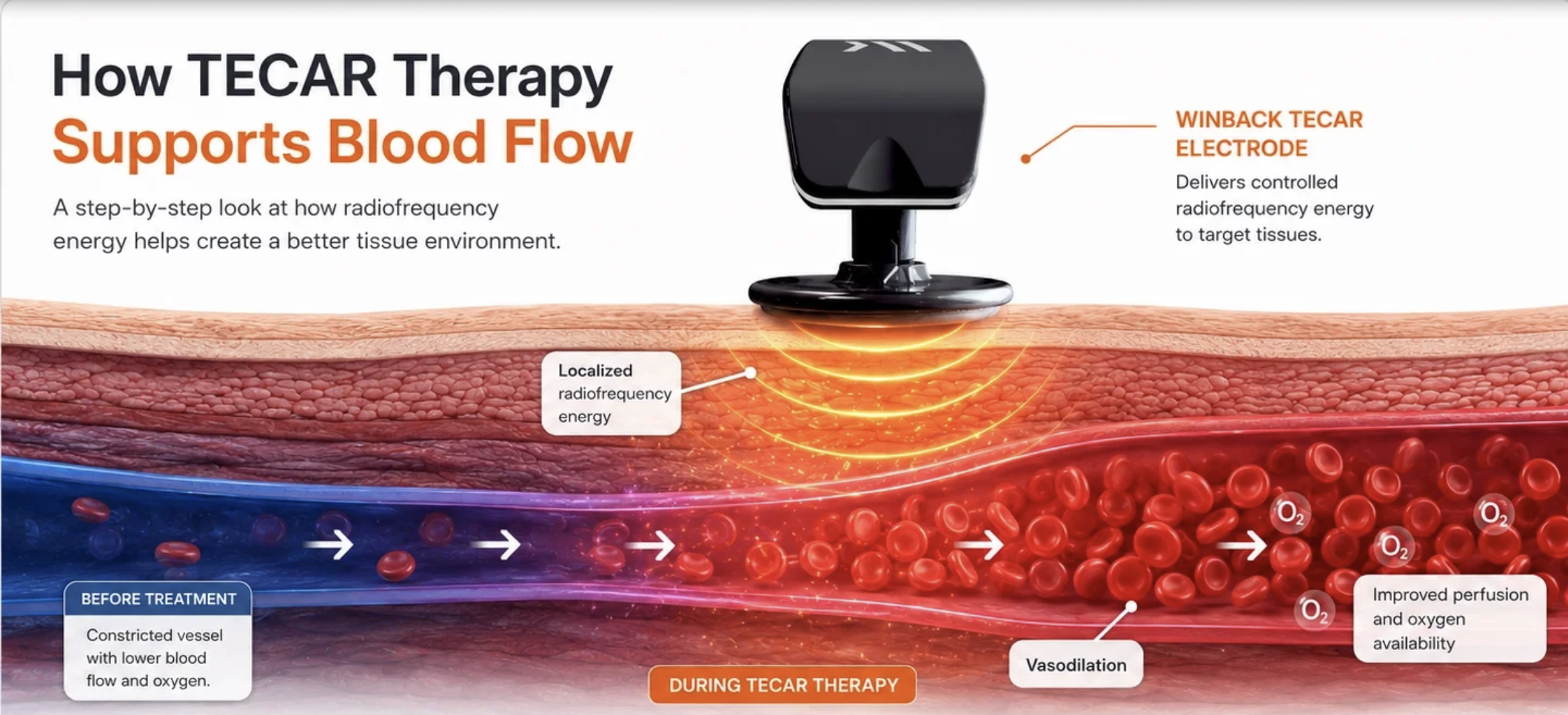
TECAR stands for Transfer of Energy Capacitive and Resistive therapy. It uses radiofrequency energy delivered through an electrode placed against the body.
The technology can be applied in two primary modes:
Capacitive energy transfer is generally used to emphasize tissues with a higher water content, including muscles and other soft tissues.
Resistive energy transfer is generally used to emphasize denser tissues, including tendons, ligaments, and structures near joints.
The radiofrequency energy interacts with the body’s tissues and can increase local tissue temperature, circulation, and metabolic activity. These effects may help decrease pain and stiffness while making it easier for a patient to participate in movement, manual therapy, and corrective exercise.
What Does the Research Say About TECAR Therapy?
The current evidence surrounding TECAR therapy is encouraging, but it is still developing.
A 2025 clinical commentary published in the International Journal of Sports Physical Therapy reviewed the existing TECAR literature. The authors found potential benefits for pain reduction, range of motion, tissue recovery, and certain measures of athletic performance. They also emphasized that many studies have small sample sizes, short follow-up periods, and different treatment protocols.
A 2022 systematic review and meta-analysis reported greater reductions in musculoskeletal pain among patients receiving TECAR therapy compared with control groups. However, the studies included in the analysis varied considerably, which means the results should be interpreted carefully.
Individual clinical trials have also produced promising findings.
In a randomized clinical trial involving people with chronic nonspecific low back pain, manual therapy combined with TECAR produced greater improvements in pain, disability, and pressure-pain tolerance than manual therapy alone. TECAR did not produce additional improvements in every measurement, including lumbar mobility.
A 2025 sham-controlled trial involving athletes with chronic adductor-related groin pain found that TECAR was associated with reduced pain and improved hip-adduction range of motion. Other measurements, including strength and several functional outcomes, did not differ significantly between groups.
Research has also shown that capacitive and resistive energy transfer can increase tissue temperature and oxygenated hemoglobin levels. These physiological changes may help explain why some patients experience improvements in pain and tissue mobility.
Taken together, the research suggests that TECAR may be a valuable addition to rehabilitation—but it should not be presented as a replacement for assessment, exercise, or progressive loading.
TECAR Therapy Is a Tool, Not the Entire Plan
Pain relief can be an important first step, but feeling better temporarily is not the same as being ready to return to full activity.
At WellSport, TECAR therapy is used as one tool within a larger rehabilitation process. The objective is to use treatment to create an opportunity for better movement and then build on that progress through corrective exercise, strength, power, and activity-specific training.
For example, reducing pain or stiffness may allow you to perform an exercise with better control. That exercise can then help rebuild the strength and capacity needed to tolerate running, lifting, golf, tennis, or another activity.
This is why TECAR is most valuable when it is paired with:
- A thorough physical assessment
- Manual therapy when appropriate
- Corrective and rehabilitative exercise
- Progressive strength training
- Sport- or activity-specific movement
- Objective reassessment throughout the process
The technology can support the process. It cannot replace the process.
Who May Benefit From TECAR Therapy?
Depending on the results of an evaluation, TECAR may be considered for people dealing with:
- Persistent muscle or joint pain
- Low back or shoulder pain
- Muscle strains
- Tendon or ligament irritation
- Restricted or uncomfortable movement
- Sports-related overuse injuries
- Difficulty tolerating the early stages of rehabilitation
Not every painful condition requires TECAR, and two people with pain in the same area may need completely different plans. The decision should be based on the source of the problem, the patient’s health history, and the activities they need to return to.
Is TECAR Therapy Safe?
TECAR is generally used as a noninvasive rehabilitation treatment, but it is not appropriate for everyone.
The clinical literature identifies several important precautions and contraindications, including certain implanted electronic devices, suspected blood clots, active infection, treatment over malignant tissue, and pregnancy in particular treatment regions.
Before beginning treatment, tell your provider about any implanted medical device, current pregnancy, cardiovascular condition, active infection, cancer treatment, or history of blood clots. A qualified provider should determine whether TECAR is appropriate for your specific situation.
How Many TECAR Treatments Are Needed?
There is no universal number of TECAR sessions that works for every patient.
Research protocols have ranged from a single treatment to multiple sessions delivered over several weeks. The right frequency depends on your diagnosis, symptoms, response to treatment, and overall rehabilitation plan.
Your progress should be measured by meaningful changes in pain, movement, strength, and function—not simply by completing a predetermined number of appointments.
Is TECAR Therapy Proven?
TECAR therapy has a growing evidence base, with studies reporting potential benefits for musculoskeletal pain and selected functional outcomes. It would be inaccurate, however, to say that it has been definitively proven for every injury or patient population.
The most accurate description is that TECAR is a promising adjunctive treatment. More large, long-term, sham-controlled trials are needed to determine which patients are most likely to benefit and which treatment protocols are most effective.
That is why clinical judgment and objective reassessment remain essential.
Find Out Whether TECAR Fits Your Rehabilitation Plan
The newest technology is only valuable when it helps solve the right problem.
At WellSport, we begin by understanding your symptoms, movement, history, and goals. From there, we determine which combination of treatment, exercise, and progressive training gives you the best path back to the activities you care about.
Request a Discovery Call to determine whether WellSport’s approach—and TECAR therapy—may be a fit for your needs.
Sources
- Lupowitz LG, Ramus L, Delacour F, Johnson K. “TECAR Therapy: A Clinical Commentary on its Evolution, Application, and Future in Rehabilitation.” International Journal of Sports Physical Therapy. 2025;20(4):632–640. DOI: 10.26603/001c.130909.
- Sadri S, Vahdatpour B, Haghighat S, Sadri L, Taghian M. “Effects of Transfer Energy Capacitive and Resistive on Musculoskeletal Pain: A Systematic Review and Meta-Analysis.” Galen Medical Journal. 2022;11. DOI: 10.31661/gmj.v11i.2407.
- Tashiro Y, Hasegawa S, Yokota Y, et al. “Effect of Capacitive and Resistive Electric Transfer on Haemoglobin Saturation and Tissue Temperature.” International Journal of Hyperthermia. 2017;33(7):696–702. DOI: 10.1080/02656736.2017.1295328.
- Kasimis K, Iakovidis P, Lytras D, et al. “Short-Term Effects of Manual Therapy Plus Capacitive and Resistive Electric Transfer Therapy in Individuals with Chronic Non-Specific Low Back Pain.” Medicina. 2023;59(7):1275. DOI: 10.3390/medicina59071275.
- Nazari S, Mansour Sohani S, Sarrafzadeh J, et al. “The Effects of TECAR Therapy on Pain, Range of Motion, Strength and HAGOS Outcomes in Athletes with Chronic Adductor-Related Groin Pain.” BMC Musculoskeletal Disorders. 2025;26:76. DOI: 10.1186/s12891-025-08304-9.
This article is intended for general educational purposes and is not a substitute for individualized medical evaluation, diagnosis, or treatment.